You Used to Know Your Doctor's Waiting Room Better Than Your Own Living Room
There was a time when going to the doctor was an event. Not in the dramatic sense — nobody was excited about it — but in the way that it carved out a full chunk of your day and handed it back to you filled with something unexpected. A conversation. A wait. A weird old magazine. A stranger's story about their gallbladder.
Today, you get a text reminder, a parking validation code, a check-in kiosk, and twelve minutes with a physician who's already typing your symptoms into a tablet before you've finished describing them. Efficient? Absolutely. But something quietly disappeared along the way, and most of us didn't notice until it was already gone.
The Waiting Room as a Social Institution
In the mid-twentieth century, a visit to the family doctor in small-town or suburban America was less like a scheduled transaction and more like an unplanned community gathering. You arrived, told the receptionist your name, and then you sat — sometimes for an hour, sometimes for two — in a room full of people doing exactly the same thing.
Those rooms had a specific texture to them. The chairs were sturdy and slightly too firm. There was a fish tank in the corner more often than not. A low table stacked with issues of Life, Reader's Digest, and the occasional Sports Illustrated from a season that had already ended. Children played on the floor. Older folks chatted across the aisle. You'd catch someone's eye, nod, and before long you'd know their name and the name of their condition.
Nobody thought of it as networking. Nobody called it community. It just was. The waiting room was a place where Americans from different walks of life sat in the same discomfort, shared the same boredom, and occasionally said something real to each other.
Your family doctor — and it usually was your family doctor, one person who knew your history, your parents' history, and your tendency to downplay pain — would eventually appear at the door, call your name, and lead you into a small exam room that smelled like antiseptic and familiarity.
When the Clock Took Over
The shift didn't happen all at once. It crept in through decades of insurance pressure, liability reform, and the slow digitization of medical records. By the 1990s, practices were already feeling the squeeze to see more patients per day. By the 2000s, electronic health records had changed the rhythm of appointments entirely. The doctor's eyes moved from your face to the screen. The visit became structured around documentation rather than conversation.
Today, many large health systems operate on what's essentially an assembly line model. You book online, receive automated reminders, check in via a touchscreen kiosk, and are ushered through a sequence of rooms — vitals here, questions there, physician last — before being discharged with printed instructions and a follow-up link.
It's not cynical to note that this is, in many ways, genuinely better. Wait times have dropped. Diagnostic accuracy has improved. Medication errors are down. Telemedicine means you can see a provider without leaving your house, which for people in rural areas or with limited mobility is a genuine revolution.
But the math of efficiency has costs that don't show up on the balance sheet.
What Got Optimized Away
The average primary care appointment in the United States today lasts between fifteen and eighteen minutes. Studies have shown that doctors interrupt patients within the first eleven seconds of them describing their symptoms. The waiting room, once a buffer zone of unhurried human time, has been compressed into a logistical staging area.
And while nobody is nostalgic for genuinely long waits, something about that old slowness served a purpose. The wait gave you time to think. To organize what you wanted to say. To observe other people living their lives. It gave doctors' offices a human scale that modern efficiency has largely erased.
There's also the question of continuity. The family doctor who knew you — who remembered that you'd been anxious last year, who asked about your wife by name — has largely been replaced by rotating hospitalists, urgent care walk-ins, and provider networks where you might see a different face every visit. The relationship has become transactional in a way it never used to be.
One thing that rarely gets mentioned: those long waits, as frustrating as they were, created a kind of enforced stillness. You couldn't check your phone, because there was no phone to check. You sat, and you waited, and sometimes you thought, and sometimes you talked to someone you'd never meet again. That was its own kind of medicine.
The Room We Replaced
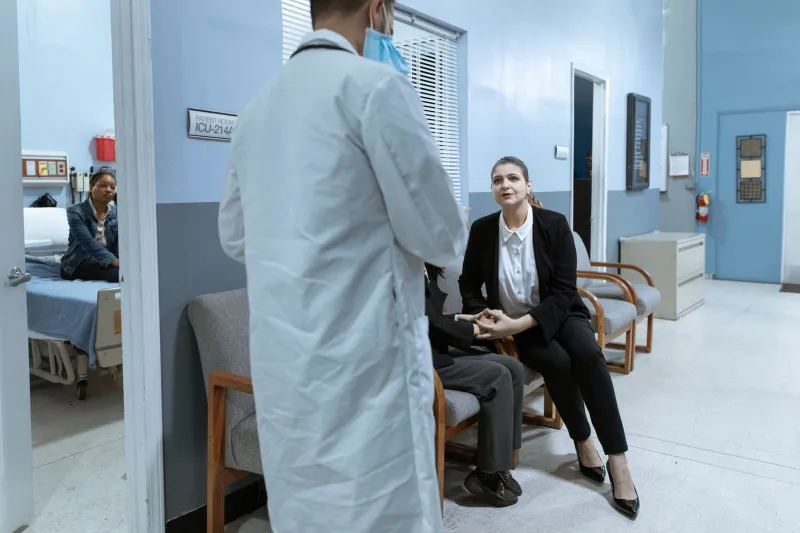
Modern waiting rooms, where they still exist, are quieter now. People stare at their phones. The magazines are gone, replaced by mounted screens cycling through health tips. The fish tanks are mostly gone too. The conversations between strangers have faded to near silence.
Some practices are experimenting with concierge models that bring back the long appointment, the unhurried conversation, the doctor who actually knows you. But those are premium services, available at a premium price. The leisurely, social waiting room of mid-century America was, for all its inefficiency, a democratic space. Rich and poor sat in the same chairs, read the same magazines, waited the same wait.
We traded that for a system that moves faster and forgets more. Whether that's progress depends on what you think medicine is actually for.