Friday Night Used to Mean Somewhere You Had to Be
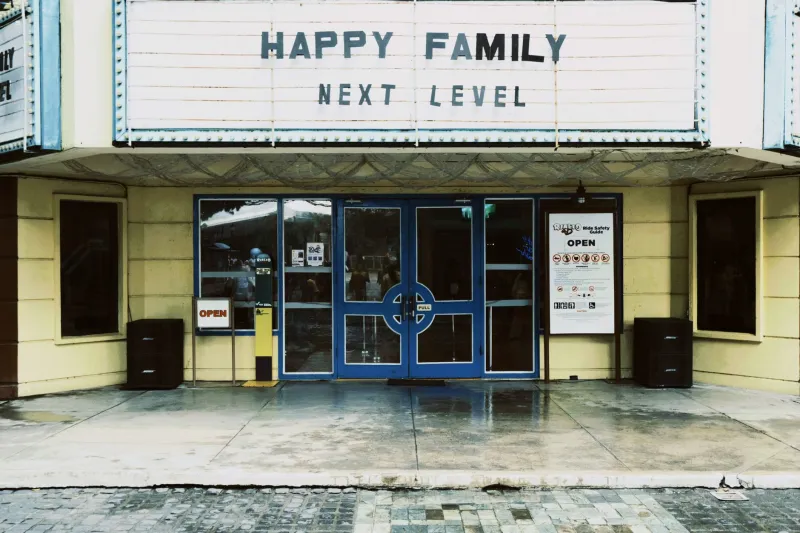
You picked the showtime three days in advance. You called the theater — an actual phone number printed in the newspaper's entertainment section — and either got a recorded message with the schedule or, in smaller towns, a real person who read it to you. You figured out who was driving. You figured out what you were wearing, because you were going out, and going out meant something. And then, on Friday night, you went.
The movie theater wasn't just a place to watch a film. It was a destination. A social occasion. In many American towns, particularly before the multiplex era, it was one of the few places a teenager could exist in public without an adult agenda attached to the evening.
The Single-Screen Era and the Church of Cinema
For much of the twentieth century, most American communities had one movie theater. Sometimes two. The building itself was often the grandest structure on Main Street — ornate lobbies with chandeliers, heavy velvet curtains, seats that felt formal in a way that signaled you were somewhere important. These weren't just buildings; they were civic institutions. The same screen that showed a Disney picture on Saturday afternoon ran a war film on Friday night and hosted the occasional community event in between.
A film's run in a single-screen theater could last weeks. If you missed opening weekend, the movie would still be there next Saturday. And if you missed that, you waited — for months, sometimes over a year — for it to arrive on network television, heavily edited and interrupted by commercials every twelve minutes. There was no other option. The theatrical window was essentially the entire experience.
This scarcity made movies feel like events rather than content. When Jaws opened in the summer of 1975, the lines wrapped around the block in cities across the country. People waited in the heat for hours. The film's release was a cultural moment in the truest sense — a shared national experience happening simultaneously in thousands of theaters, with no pause button and no second screen.
The Drive-In Was Its Own Universe
And then there was the drive-in. At its peak in the late 1950s, America had more than four thousand drive-in theaters operating across the country. They were a uniquely American invention — part cinema, part parking lot, part social scene — and they occupied a specific cultural space that no streaming service will ever replicate.
You drove in, hung the speaker on your window, and watched the movie from inside your own car. Families brought lawn chairs and coolers. Teenagers found privacy in a way that required no explanation. The double feature meant you got two films for the price of one, and the intermission — complete with animated concession stand advertisements that became their own cultural artifacts — gave you time to visit the snack bar or simply stretch your legs under the open sky.
The decline of the drive-in came in waves: the energy crisis of the 1970s, changing suburban land values, the arrival of home video. Today fewer than three hundred operating drive-ins remain in the United States, many of them running on nostalgia as much as ticket revenue.
Dressing Up to Sit in the Dark
It sounds almost absurd now, but there was a period in American life when going to the movies was a dress-up occasion. Not formal, necessarily, but deliberate. You didn't wear what you'd worn all day. You put on something that acknowledged you were going somewhere.
This wasn't vanity — it was a form of social participation. The theater was public space, and public space carried expectations. You were going to be seen by your neighbors, your classmates, your coworkers. The experience of the film was partly inseparable from the experience of experiencing it with other people, strangers included. The collective gasp at a plot twist. The shared laughter that makes a comedy funnier than it would be alone. The silence that falls over an audience during a scene that really lands.
That communal dimension was the product of scarcity and architecture. You couldn't pause it. You couldn't rewind it. You were in it together, and the darkness made everyone equal.
How the Multiplex Changed the Math
The multiplex era of the 1980s democratized access and destroyed exclusivity simultaneously. Suddenly you could choose from eight films instead of one, which was genuinely liberating. But the grand single-screen theaters that anchored downtowns were replaced by suburban boxes near the highway, and the civic character of moviegoing began to erode.
Home video arrived and gave people their first real alternative. Then DVD. Then streaming — first Netflix mailing discs, then Netflix streaming, then a cascading proliferation of platforms that now compete directly with theatrical releases. In 2020, the pandemic forced studios to experiment with simultaneous theatrical and digital release, and the results were revealing: audiences discovered they were comfortable watching new films at home, and many never fully came back.
The economics have shifted accordingly. Theatrical attendance in the United States has not recovered to pre-pandemic levels. Major studios have accelerated their streaming windows. The concept of waiting — of a film being unavailable except in a theater — has been nearly eliminated.
What the Couch Can't Replicate
Home viewing has real advantages that aren't worth dismissing. It's cheaper. It's accessible to people who can't easily get to a theater. It lets you watch on your own schedule, in your own clothes, with your own snacks at a fraction of the concession price. These are not trivial benefits.
But something was embedded in the ritual of going out that the couch can't reconstruct. The anticipation. The social negotiation of choosing a film with other people. The shared silence of a darkened room full of strangers who all chose to be there. The conversation afterward, in the parking lot or at the diner, while the film was still fresh and everyone was still a little inside it.
Streaming gives you more. It gives you everything, essentially, whenever you want it. What it can't give you is the feeling that what you're watching matters enough to leave the house for.
Friday night used to mean somewhere you had to be. Now it means something good dropped on a platform and you'll get to it eventually. The movie is still there. The occasion is what's gone.