The Man With the Lasting Sole — How America Forgot How to Fix Its Own Shoes
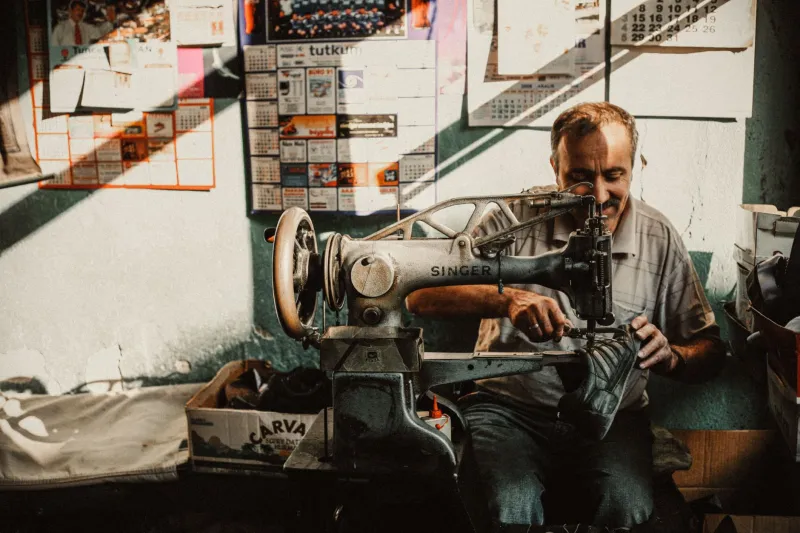
The sign was usually small. Sometimes handwritten. A shoe with a needle through it, or just a name above a narrow door — DiMaggio's Shoe Repair, or Kowalski's, or just "The Cobbler" in faded paint. You'd push through the door and be hit immediately by the smell: leather and adhesive and something faintly mechanical, like a workshop that took its work seriously.
The cobbler would look at your shoes the way a doctor looks at a patient. He'd turn them over, press a thumb against the heel, check the stitching. Then he'd give you a verdict and a ticket, and you'd come back Thursday to find them restored — resoled, re-heeled, buffed back to something resembling dignity. You'd hand over a few dollars and walk out wearing the same shoes you'd walked in with, except they had another two years of life in them.
That transaction, ordinary as it was, represented a whole philosophy of ownership that Americans have largely abandoned.
When Shoes Were Worth Fixing
For most of American history, shoes were a significant household expense. A good pair of leather work shoes or dress shoes might cost the equivalent of several days' wages. Families didn't own many pairs. Children wore hand-me-downs. Adults wore the same shoes to work for years, maybe decades, rotating between two pairs if they were lucky.
In that economic reality, repair wasn't a lifestyle choice — it was just common sense. You no more threw away a worn shoe than you threw away a coat with a torn lining. You fixed it, because the alternative was an expense you couldn't easily absorb. The cobbler's shop existed to serve that need, and in doing so, it occupied a quiet but essential place in the fabric of every American town.
Shoemakers and cobblers were skilled tradespeople who served apprenticeships, learned their craft over years, and took genuine pride in what they could restore. A good cobbler could rebuild a shoe from near-ruin. He could replace a welt, re-stitch a seam, patch a split upper, and match a dye so closely you'd forget the shoe had ever been damaged. It was craftsmanship in the truest sense — knowledge applied to material to extend its useful life.
The Cheap Shoe Changed Everything
The unraveling of the shoe repair trade tracks almost exactly with the rise of mass-produced, inexpensive footwear — and later, with the wave of imported shoes that flooded American retail from the 1970s onward.
As manufacturing moved overseas and synthetic materials replaced leather in mainstream footwear, the economics of repair quietly inverted. By the 1980s and accelerating through the 1990s, it was often cheaper to buy a new pair of shoes than to have an old pair professionally repaired. Not because cobblers raised their prices — their labor costs were actually modest — but because the shoes themselves had become so inexpensive, and so poorly constructed, that they weren't worth the cost of repair even when that cost was low.
You can't resole a shoe that was glued together with no welt. You can't re-stitch a synthetic upper that's started to delaminate. The very design of cheap modern footwear assumes disposability. It's not a flaw; it's the business model. Shoes are now engineered to be worn for a season and replaced, feeding a cycle of consumption that keeps retail moving and keeps prices low enough that the math of repair never quite works out.
The cobbler didn't lose to a competitor. He lost to an economic system that decided his services were unnecessary by making the thing he fixed not worth fixing.
What the Numbers Tell Us
The decline of the shoe repair industry in America is striking in its consistency. At their peak in the mid-twentieth century, there were an estimated 120,000 shoe repair shops operating across the country. By the 1980s, that number had dropped to around 40,000. Today, estimates put the figure somewhere between 7,000 and 10,000 — mostly small, family-owned operations clustered in cities where older clientele still seek them out and higher-end shoes still justify the cost of maintenance.
The people still using cobblers tend to be those who own quality leather shoes — the kind of footwear that costs several hundred dollars and is built to last if properly maintained. There's a certain irony in that: the shoe repair trade, once the resource of working-class families stretching every dollar, has become something of a niche service for people who can afford to buy well in the first place.
For everyone else, the calculation is simple and a little dispiriting: a new pair of sneakers from a big-box retailer costs less than a resoling job. So you buy new, and the old pair goes in a bag to the donation bin or the trash.
A Lens on the Throwaway Economy
The cobbler's story isn't really about shoes. It's about a fundamental shift in how Americans relate to the objects in their lives — a shift from ownership to consumption, from maintenance to replacement, from things that last to things that are meant to be discarded.
That shift touches everything. Appliances that aren't designed to be repaired. Electronics that are sealed against the screwdriver. Furniture built from particleboard that doesn't survive a second move. Clothing made so cheaply that tailoring costs more than the garment itself. In each case, the logic is the same: replacement is cheaper than repair, so the infrastructure of repair disappears, which makes replacement even more inevitable, which completes the loop.
The environmental cost of this loop is enormous and increasingly well-documented. The fashion industry alone is one of the world's largest polluters. Americans throw away roughly 300 million pairs of shoes every year. Most end up in landfills, where synthetic materials take centuries to break down.
But there's also a cultural cost that's harder to quantify. When repair disappears as a viable option, so does the mindset that values things for their durability rather than their novelty. We stop asking whether something is well-made. We stop expecting it to last. We stop building relationships with objects, and by extension, with the skilled people who once maintained them.
The Cobbler's Quiet Return
There are small signs of reversal. A generation of younger consumers, motivated partly by environmental concern and partly by a genuine appreciation for quality, has begun seeking out cobblers for high-end footwear. Resoling a pair of good boots is having a modest cultural moment in certain circles. Online shoe repair services have emerged to serve customers in cities where walk-in cobblers are hard to find.
But it's a niche, not a movement. The economics of mass consumption haven't changed, and cheap shoes haven't gotten any more repairable.
What has changed, perhaps, is awareness. More Americans are beginning to notice the cost — financial, environmental, and cultural — of the throwaway habit. The cobbler's shop isn't coming back. But the idea behind it — that a thing worth owning is a thing worth maintaining — might be worth reviving anyway.
Some lessons are stitched into the sole.