Thirty Volumes Knew Everything Worth Knowing — Before the Internet Gave Us Everything and Nothing

Photo by Photo by Clay Banks on Unsplash on Unsplash
It sat on a shelf in the living room, or maybe in the den, or sometimes in the hallway between the bedrooms. Twenty-four volumes, maybe thirty, bound in dark green or burgundy or that distinctive cream-and-gold of the Britannica. Heavy enough that pulling one out felt like an event. Authoritative enough that when it said something, the conversation was usually over.
The family encyclopedia set was, for most of the twentieth century, the closest thing an American household had to a complete library of human knowledge. And it was enough. More than enough, actually. It was curated, trusted, and finite — three qualities that, in retrospect, were worth far more than anyone realized at the time.
The Encyclopedia as a Cultural Object
Encyclopedia salesmen were a fixture of postwar American suburban life. They arrived at the door with samples, pitches, and payment plans, and they sold parents on the idea that buying a set was an investment in their children's futures. It wasn't a crazy pitch. In an era before public libraries were in every neighborhood and before any information was a search query away, owning a set of encyclopedias meant owning access.
Encyclopedia Britannica, first published in Scotland in 1768, became the gold standard. World Book was the friendlier, more American alternative, designed explicitly for students and widely adopted by families with school-age children. Collier's, Americana, Compton's — there were options at different price points, but the basic proposition was the same: here is what humanity has figured out, organized alphabetically, checked by experts, and printed for your household.
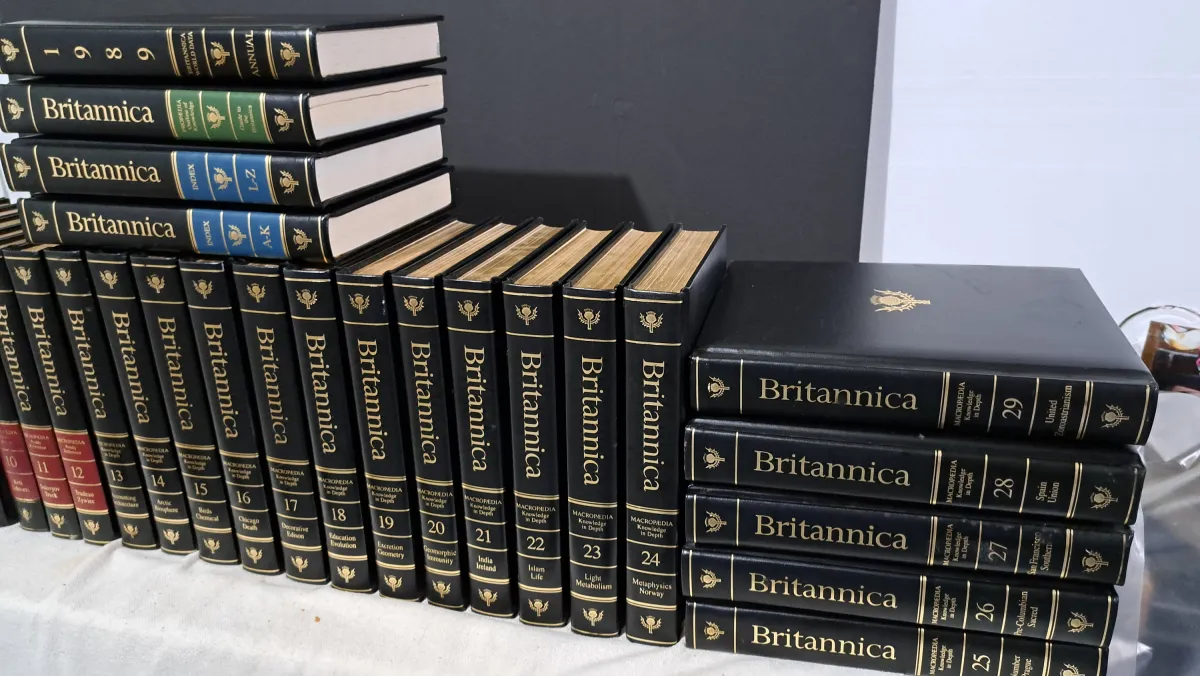 Photo: Encyclopedia Britannica, via i.etsystatic.com
For a generation of American kids, the encyclopedia was where curiosity went to get answered. You wondered how volcanoes worked, you pulled out the V volume. You needed to know when the Civil War ended, you pulled out the C. You didn't always find exactly what you were looking for, but what you found was reliable. It had been written by someone who knew the subject. It had been edited. It had been checked.
 Photo: Civil War, via i.pinimg.com
The Deliberate Nature of Looking Things Up
There's something worth pausing on about the experience of using an encyclopedia that has no modern equivalent: it required a small but meaningful commitment.
You had to get up. You had to find the right volume. You had to flip through pages. And because the information was finite — because the encyclopedia contained what it contained and nothing else — you often found yourself reading adjacent entries, discovering things you hadn't gone looking for. You came for volcanoes and stayed for the Vikings. The serendipity was built into the format.
That kind of discovery is technically possible on the internet. Wikipedia has a well-known rabbit-hole quality. But the experience is different in ways that matter. Online, you're never more than two clicks from a conspiracy theory, an advertisement, a hot take, or content designed to provoke rather than inform. The encyclopedia had no algorithm trying to hold your attention. It had no incentive to outrage you. It just had information, and then it stopped.
What Happened When Everything Became Available
The internet arrived and changed everything about how people access information, and the early promise was genuinely thrilling. Any fact, any topic, any question — answered instantly, for free, from anywhere. The encyclopedia seemed quaint overnight. Britannica stopped printing its physical edition in 2012, after 244 years. It felt like the end of something, though at the time most people were too excited about Google to notice.
But the promise of infinite information carried a hidden cost that only became clear over time: when everything is available, nothing feels definitive. When anyone can publish anything, the question of what to trust becomes exhausting. The encyclopedia's authority came partly from its scarcity — it was hard to produce, expensive to distribute, and edited by people with credentials. The internet abolished those friction points entirely, which was liberating and destabilizing in equal measure.
Today, a single health question can return results ranging from peer-reviewed medical guidance to wellness blogs selling supplements to forums where anonymous strangers share anecdotes. All of it looks roughly the same on a screen. The work of sorting credible from questionable has been transferred entirely to the reader — and most readers aren't equipped for it, nor should they have to be.
The Argument for Knowing Less, Better
There's a genuinely interesting question buried in all of this: were people who learned from encyclopedias actually worse informed than people who learn from the internet today?
The encyclopedia got things wrong sometimes. It reflected the biases of its era — entries written by mostly white, mostly male, mostly Western academics carried blind spots that are obvious in retrospect. It went out of date. A 1965 set of Britannicas had no entry for the moon landing.
But within its limitations, it offered something the internet rarely does: a shared, stable, commonly agreed-upon version of reality. When two people consulted the same encyclopedia, they were working from the same foundation. Disagreements were about interpretation, not about whether the basic facts were real.
In an era when a significant portion of Americans believe things that are demonstrably false — about medicine, history, science, current events — the value of a single authoritative source that most people trusted looks different than it did in 1995.
What Sat on That Shelf Was More Than Books
The encyclopedia set was a physical declaration that knowledge mattered enough to make space for it in your home. It sat there, heavy and permanent, a reminder that the world was large and worth understanding. Kids who grew up with it learned that answers existed, that they could be found, and that finding them was worth the effort of walking across the room.
We traded that for a device in our pocket that contains more information than every encyclopedia ever printed — and yet somehow makes it harder than ever to know what's actually true.
The volumes are gone from most living room shelves now. What replaced them is extraordinary and maddening in equal measure. And occasionally, late at night, scrolling through a third contradictory article about something you just wanted a straight answer on, you might find yourself wishing for something finite. Something edited. Something that just told you the answer and then stopped.