Flying Used to Feel Like an Occasion — Now It Feels Like a Bus Ride You Pay Extra For
There's a photograph that circulates occasionally on aviation history forums. It shows the interior of a Pan Am Boeing 747 from around 1970. The seats are wide. The aisles are generous. Passengers are dressed as though they're going somewhere that matters — because in 1970, they were. Flying was an event. You dressed for it, saved for it, and remembered it.
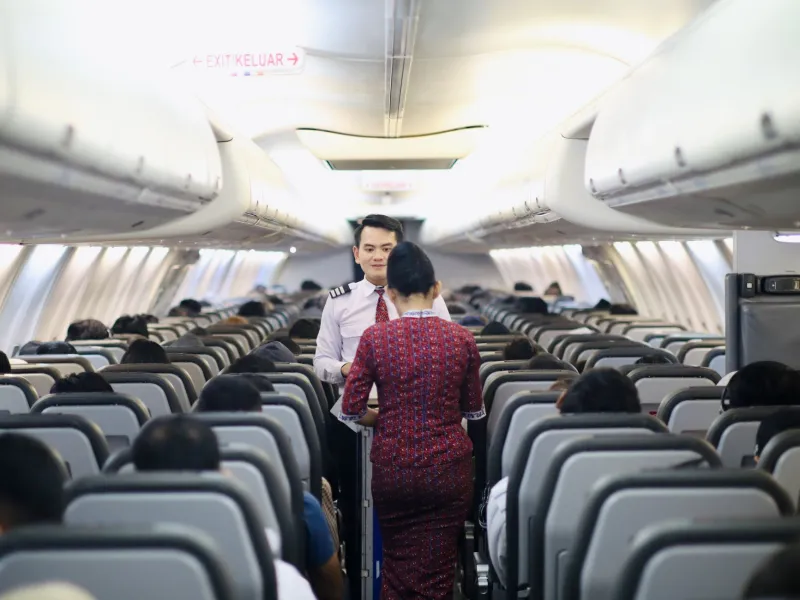
Compare that image to any photo of a modern domestic economy cabin and you're looking at two completely different propositions, separated by roughly fifty years of relentless space reduction.
The Numbers Tell the Story
Let's start with the measurements, because the numbers are genuinely startling.
In the 1970s and early 1980s, the standard seat pitch — the distance from one point on a seat to the same point on the seat directly in front — was typically between 34 and 36 inches on domestic US flights. On some carriers, particularly on international routes, it ran even more generous. That's enough space to sit without your knees touching the seat back, to retrieve something from the bag under the seat in front of you without a yoga-adjacent maneuver, and to actually recline without creating a diplomatic incident with the passenger behind you.
Today, the average economy seat pitch on major US domestic carriers sits between 28 and 31 inches. Several budget carriers have pushed it as low as 28 inches. That's a reduction of up to eight inches — roughly the width of a standard piece of printer paper — removed from the space between you and the person in front of you.
Seat width has followed the same trajectory. Where economy seats in the 1970s commonly measured 18 to 18.5 inches across, many modern economy seats run 17 to 17.2 inches. Again, the difference sounds small until you're sitting in it for four hours next to someone of any normal adult size.
When Flying Was Actually an Experience
The physical dimensions are only part of what changed. The entire culture of air travel transformed alongside the seat measurements.
Through the 1970s and into the 1980s, even domestic coach passengers received genuine meal service on flights of any meaningful length. Not a bag of pretzels and a can of soda — actual hot food, served on trays with real cutlery on longer routes. Transcontinental flights included multi-course meals. Drinks were included. Flight attendants, then called stewardesses in an era that had its own complicated problems, were staffed generously enough to provide attentive service rather than the efficient but hurried presence they're expected to maintain today on aircraft with far more seats per crew member.
The passenger experience was designed around the idea that flying was special. Airlines competed on service, not just price. The Civil Aeronautics Board regulated fares until deregulation in 1978, which meant carriers couldn't undercut each other on ticket prices — so they competed on what they offered inside the aircraft instead.
Deregulation changed everything. Once airlines could compete on price, price became the primary battleground. And the most direct path to lower prices was lower costs, which meant fewer staff, less food, and — most significantly — more seats per aircraft.
How They Fit More People Into the Same Tube
Aircraft manufacturers didn't make planes dramatically bigger to accommodate the seat explosion. They just installed more rows inside the same fuselage. A Boeing 737 that might have carried 100 passengers in 1975 now routinely carries 160 or more. The plane is the same size. The seats are smaller and closer together. The math is straightforward and the experience reflects it.
Airlines discovered, particularly after the rise of online fare comparison tools in the 2000s, that most American travelers would choose the cheaper ticket even when it meant a worse experience. The race to the bottom became self-reinforcing: as seat quality declined across the industry, passengers adapted their expectations downward, which justified further reductions.
The introduction of unbundled fees — pioneered aggressively by Spirit and Frontier, then adopted in modified form by the legacy carriers — completed the transformation. By charging separately for checked bags, carry-on bags, seat selection, early boarding, and in some cases even printing a boarding pass at the airport, airlines found they could advertise a low base fare while extracting comparable or greater revenue per passenger than they had with higher all-in fares. The experience got worse. The revenue per seat got better.
The Passenger Who Shrank
Here's the irony that aviation observers point out regularly: the average American has gotten physically larger over the past fifty years, while the average airline seat has gotten physically smaller. The CDC reports that the average American adult weighs roughly 20 pounds more today than in the 1970s and is slightly taller. The industry response to this reality has been to reduce the space allocated per passenger.
The collision of these two trends produces the modern economy cabin experience: a space that was already smaller than its predecessor, now occupied by larger bodies than it was designed for, on routes that have added fees for the privilege.
You Can Still Buy Space — If You Can Afford It
The aviation industry's answer to all of this is, essentially, that you can purchase your way back to the 1978 experience. Premium economy, business class, and first class cabins on most major carriers offer seat pitches and widths that approximate or exceed what coach passengers received in the golden era of domestic flying. The experience is available. It just costs significantly more than the base fare that most Americans are comparing when they book.
What this means in practice is that air travel has stratified in a way that it wasn't during the regulated era. The difference between a first-class seat and an economy seat on a transcontinental flight today is, in some measurable ways, greater than the difference between flying and not flying at all — in terms of comfort, service, and the basic sense that you are a person the airline is glad to have aboard.
The Occasion That Became an Ordeal
None of this means flying isn't remarkable. The physics of hurtling through the air at 35,000 feet in a metal tube remains astonishing. The fact that you can board a plane in New York at 7 AM and be in Los Angeles before noon is genuinely extraordinary by any historical measure.
But the experience that surrounds that physics — the seats, the food, the fees, the space — has been systematically stripped back to the point where the miracle of flight has been repackaged as something to simply endure. We arrived at cheap and accessible and gave up comfortable and dignified to get there.
The man in that 1970 Pan Am photograph doesn't know how good he has it. He's just sitting there, legs uncrossed, eating his meal, waiting to land. Taking up space like it's the most natural thing in the world.