Full Service Meant Something — The Gas Station That Was Actually the Center of Town
Pull into a gas station today and the choreography is entirely predictable. You stop at the pump. You tap your card. You stand there watching the numbers climb while an advertisement plays on a small screen at eye level. You replace the nozzle, maybe grab a coffee from inside, and leave. Total human interaction: zero. Time elapsed: four minutes, maybe five.
Now rewind to 1965. You pull into the same kind of stop, except a guy in a uniform is already walking toward your car before you've finished turning off the engine. He fills the tank while someone else checks the oil and a third person wipes down your windshield with a squeegee and a chamois. You might chat for five minutes about the weather, about the road conditions up ahead, about the game last night. When you leave, you feel like you've actually been somewhere.
This isn't nostalgia for nostalgia's sake. It's a story about how a single shift in how we buy gasoline quietly rewired the way Americans interact with each other in everyday life.
The Station That Knew Your Name
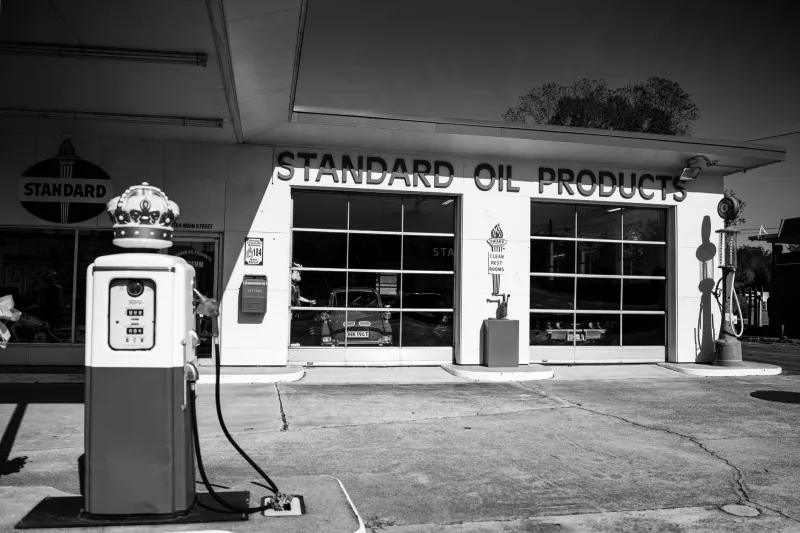
For most of the twentieth century, the gas station was genuinely central to American community life — especially in small towns and suburbs. The big oil companies understood this. Standard Oil, Texaco, Gulf — they built their stations to look like destinations. Wide canopies, tidy uniforms, a sense of occasion around something as mundane as refueling.
The attendant was a fixture. He — and it was almost always a he — knew the regulars. He knew which cars had a slow leak in the left rear tire. He knew which families were heading out on vacation because the station wagon was packed to the roof. He was, in a very practical sense, a node in the town's information network. People talked to him. He talked back.
For teenagers, the gas station was also a place to work and hang around. The garage bays attached to most stations meant there was always something mechanical happening, always someone learning something, always a reason to linger. It was loud and greasy and social in a way that felt entirely American.
Beyond the social element, full service was simply what gas stations did. Self-service pumps existed in some form as far back as the 1940s, but they were novelties and, in many states, outright illegal. Oregon and New Jersey famously kept full-service-only laws on the books for decades — Oregon finally allowing self-service as recently as 2023.
The Great Pump Handoff
The shift to self-service accelerated dramatically during the oil crisis of the 1970s. When fuel prices spiked and stations needed to cut costs fast, removing the attendant was the obvious lever to pull. Consumers, already rattled by shortages and long lines, accepted the trade-off. You pump your own gas, you save a few cents per gallon. It seemed reasonable at the time.
By the 1980s, self-service was the norm across most of the country. By the 1990s, pay-at-the-pump technology meant you didn't even have to walk inside. The transaction had been compressed into something you could complete without making eye contact with another human being. That was framed as convenience. It was also, quietly, isolation.
The garage bays disappeared next. As cars became more computerized and diagnostics more specialized, the neighborhood mechanic who happened to work at the gas station became obsolete. The station became a fuel stop and a convenience store, nothing more.
What a Contactless World Actually Costs
There's a version of this story that's purely economic. Self-service is cheaper to operate. Pay-at-the-pump is faster. Contactless payment is more hygienic. All of that is true.
But there's another version of the story that's about what happens to a society when you systematically remove the small, incidental moments of human contact from everyday transactions.
The attendant who topped off your tank wasn't providing a luxury. He was providing a reason to briefly exist in the same space as another person, to exchange a few words, to feel like a recognized member of a community rather than a unit moving through a system. Multiply that across millions of daily interactions — at the gas station, at the grocery checkout, at the bank teller window — and you start to understand why so many Americans report feeling more isolated than their parents did, even as they're more connected than ever by technology.
Sociologists have a term for these moments: weak ties. The casual, low-stakes interactions with people you don't know well but see regularly. Research consistently shows that weak ties are important to mental health and community cohesion. They're the social glue that holds neighborhoods together without anyone noticing. And we've been steadily engineering them out of daily life for fifty years.
The Last Full-Service Feeling
You can still find full-service stations in a handful of places — mostly in New Jersey, where the law survived longest, and in a few small towns where the old model never entirely gave way. Pull into one of those stations and the experience still registers as something different. Someone comes to your window. You talk. You leave having briefly been a person rather than a transaction.
It's a small thing. But it turns out a lot of small things add up. The gas station didn't just change how we fuel our cars. It changed how often we accidentally talk to people we don't know. And that, it turns out, mattered more than anyone thought to mention at the time.