When Athletes Limped Home and Never Came Back — Before Science Rewrote the Rules of Recovery

In 1970, Joe Namath's knees were so mangled that team doctors told him he'd be lucky to walk normally by age 40. The Jets quarterback played through cartilage damage, bone chips, and ligament tears with nothing more than cortisone shots and sheer willpower. When he finally retired, his legs were held together by surgical wire and hope.
Today, that same injury would sideline him for eight months — and he'd come back stronger than before.
The Verdict That Changed Everything
Fifty years ago, a serious sports injury carried the weight of a life sentence. Torn ligaments meant permanent weakness. Broken bones healed crooked. Career-ending wasn't just a phrase sportswriters threw around — it was medical fact.
Take the torn ACL, the injury that still makes athletes' hearts sink when they hear the diagnosis. In the 1960s and 70s, surgeons would simply remove the damaged ligament entirely. The thinking was straightforward: if it's torn, cut it out. Players learned to live with wobbly knees that gave out during pickup basketball games twenty years later.
Factory workers and weekend warriors faced even grimmer prospects. Without the resources of professional athletes, a blown-out shoulder or shredded Achilles tendon often meant finding a new line of work. Physical therapy consisted of "take it easy for a few weeks" and maybe some basic exercises copied from a pamphlet.
The Science of Getting Better
The transformation began quietly in research labs and teaching hospitals throughout the 1980s. Orthopedic surgeons started asking different questions. Instead of "How do we work around this damage?" they wondered "How do we actually fix it?"
Arthroscopic surgery emerged as the first game-changer. Instead of opening massive incisions to peer inside joints, surgeons could thread tiny cameras through pencil-sized holes. What once required months of recovery could now be done as outpatient surgery. The torn meniscus that would have ended a construction worker's career became a Tuesday morning procedure.
But the real revolution happened in the rehabilitation room. Sports medicine specialists began studying how tissue actually heals, mapping the precise timeline of cellular repair. They discovered that controlled movement accelerated recovery, not prolonged rest. The old prescription of "six weeks in bed" was not just wrong — it was counterproductive.
Engineering New Bodies
Modern ACL reconstruction reads like science fiction to anyone who lived through the analog era of sports medicine. Surgeons harvest tendons from elsewhere in the body — or use donor tissue — to rebuild the damaged ligament with millimeter precision. Computer imaging guides every cut. The new ligament is anchored with titanium screws and biodegradable interference screws that dissolve as bone grows around them.
The rehabilitation protocol is equally precise. Week one focuses on reducing swelling and regaining basic range of motion. Week four introduces weight-bearing exercises. Month three brings running drills. By month six, athletes are typically cleared for full competition — often with knees that test stronger than their uninjured side.
Physical therapists now use motion-capture technology borrowed from Hollywood studios to analyze how patients move. Force plates measure the exact distribution of weight across joints. Ultrasound machines provide real-time feedback on muscle activation. What was once guesswork has become engineering.
The Ripple Effect
This medical revolution didn't stay confined to professional sports. The same techniques that get NFL players back on the field trickle down to high school athletes, weekend warriors, and anyone unlucky enough to plant their foot wrong during a company softball game.
Today's 50-year-old recreational tennis player has access to treatments that would have seemed miraculous to Mickey Mantle. Platelet-rich plasma therapy speeds healing by concentrating the body's own repair mechanisms. Stem cell treatments show promise for regenerating damaged cartilage. Even basic physical therapy now incorporates sophisticated understanding of biomechanics and neuromuscular control.
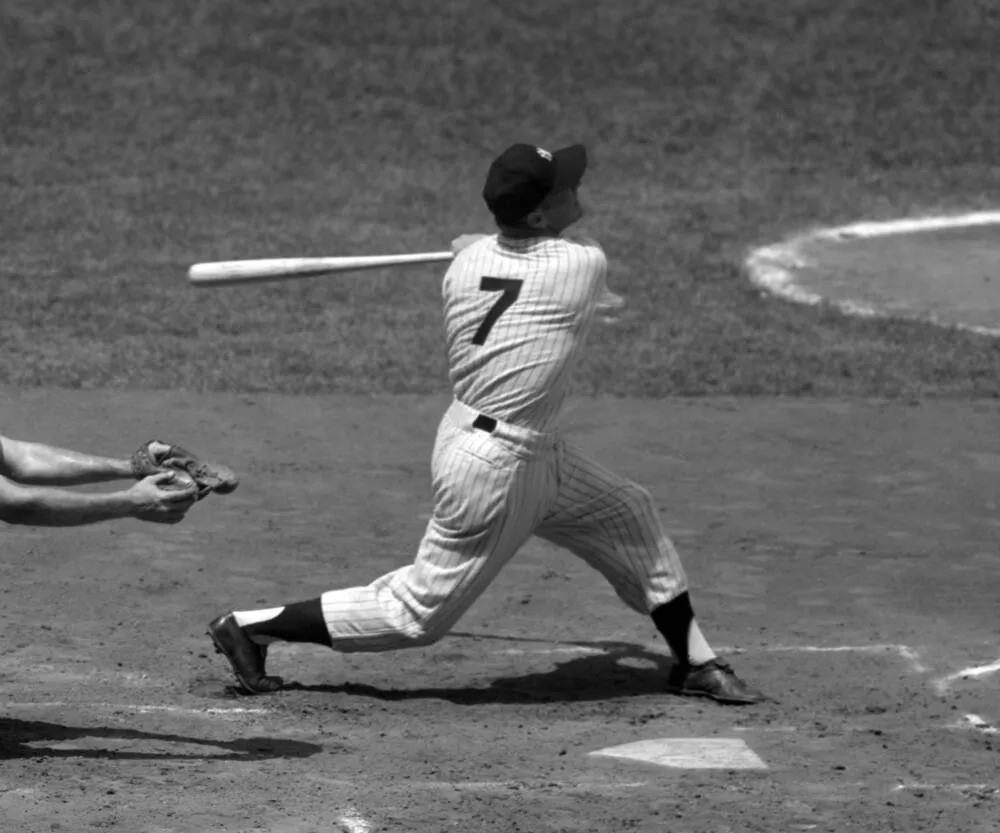 Photo: Mickey Mantle, via cdn.artphotolimited.com
The psychological impact might be even more profound. Getting hurt no longer means accepting limitation. It means planning a comeback.
What We Gained and What We Lost
The numbers tell one story: professional athletes' careers last longer now than ever before. Tom Brady played quarterback until age 45. Serena Williams dominated tennis into her late thirties. LeBron James shows no signs of slowing down at 39.
 Photo: Tom Brady, via frontofficesports.com
But there's a shadow side to this medical miracle. The expectation of perfect recovery has created its own pressure. Young athletes now undergo major surgery for injuries that previous generations played through. The line between necessary intervention and performance optimization has blurred.
Still, for the factory worker who blows out his knee at 35, or the weekend cyclist who crashes hard on a mountain trail, the transformation is unambiguously positive. They get their lives back in ways that simply weren't possible when Joe Namath was limping off football fields.
The New Definition of Broken
We've fundamentally changed what it means to be injured. A torn ACL isn't a catastrophe anymore — it's an inconvenience with a known timeline. The shoulder surgery that would have ended careers now comes with discharge instructions and a rehabilitation schedule.
Sports medicine turned recovery from an art into a science, transforming not just how we heal but how we think about the fragility of the human body. In doing so, it quietly rewrote one of life's most basic assumptions: that some things, once broken, can never quite be fixed.