The Pantry That Could Feed a Family Through February — Before We Outsourced Winter to the Grocery Store
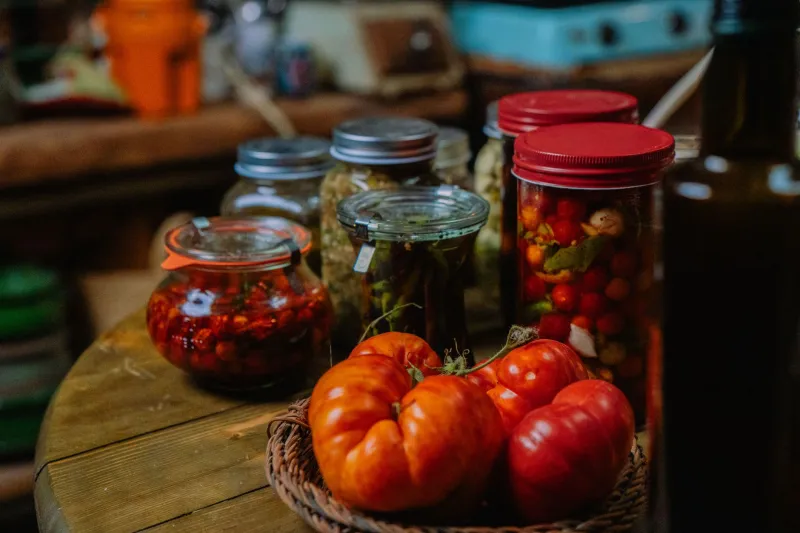
In the back of a lot of older farmhouses, behind the kitchen or tucked under the stairs, you'll sometimes find a room that modern real estate listings call a "bonus space" or a "flex room." A hundred years ago, it had a specific name and a specific purpose: the root cellar, or the canning pantry. Its shelves were lined floor to ceiling with glass jars, and what was inside those jars was the difference between a family eating well in January and a family going hungry.
This was not a hobby. It was infrastructure.
When the Harvest Didn't Wait for Convenience
Before refrigeration became standard in American homes — which didn't happen in most rural households until the late 1940s and '50s — the window between growing food and losing food was brutally short. Tomatoes ripened all at once. Corn came in fast and went soft faster. Peaches didn't wait for a convenient weekend. If you didn't process the harvest quickly, it rotted, and your winter options narrowed considerably.
Home canning — sealing cooked food in glass jars to halt bacterial growth and preserve it for months — became one of the most essential domestic skills in American life. The USDA was actively promoting it by the early 1900s. During both World Wars, the federal government ran national campaigns encouraging families to can their own food as a patriotic act, freeing up commercial food supplies for the troops. Millions of American households answered the call. In 1943 alone, an estimated four billion jars of home-canned food were produced by American families.
Four billion jars. In a single year. By people who also had jobs, children, and farms to run.
The Skill That Lived in the Hands
What's easy to miss, looking back, is how much genuine expertise this required. Home canning isn't complicated, but it demands precision. The wrong temperature, an improperly sealed lid, or a jar of low-acid vegetables processed without a pressure canner can produce conditions where Clostridium botulinum — the bacterium behind botulism — thrives silently and invisibly. People died getting it wrong. People fed their families for decades getting it right.
The knowledge was passed down physically, in kitchens, between women who had learned from their mothers and grandmothers. You watched the jars for the satisfying pop of a successful seal. You learned to tell by the sound whether the lid had set properly. You kept a written record of what you'd put up and when, rotating stock through the pantry the way a small grocery store rotates its shelves.
Beyond canning, preservation took other forms. Smoking and salting meat. Drying fruits and vegetables. Fermenting cabbage into sauerkraut, cucumbers into pickles, milk into cheese. Root cellaring potatoes, carrots, and apples in cool, dark conditions that slowed their metabolism without stopping it. Each technique was a distinct skill set with its own learning curve and its own margin for error.
Taken together, these skills represented something that's become genuinely rare in modern life: the ability to feed yourself without depending on anyone else.
How the Grocery Store Took Over the Pantry
The transformation happened in stages. Rural electrification in the 1930s and '40s brought refrigerators to farmhouses that had never had them. Commercial canning and frozen food made factory-processed vegetables cheaper and more convenient than home-preserved ones. Supermarkets spread into small towns that had previously relied on general stores with limited inventory. Interstate highways made year-round fresh produce distribution economically viable for the first time.
By the 1960s, the calculus had shifted. For most American families, it was cheaper and easier to buy canned tomatoes at the A&P than to spend a hot August afternoon processing them at home. The skills didn't disappear overnight, but they stopped being taught as necessities. Grandmothers still canned. Their daughters sometimes helped. Their granddaughters often didn't learn at all.
By the 1990s, home canning had become niche enough to carry a faint whiff of eccentricity — something rural families and back-to-the-land types did, not something that defined mainstream American domestic life. Today, it's been fully absorbed into the aesthetic economy of artisanal hobbyism: Mason jar centerpieces, farmhouse kitchen Instagram accounts, and $45 canning kits sold at Williams Sonoma alongside copper measuring spoons.
The Cost of Forgetting
There's a financial argument buried in all of this that rarely gets made directly. Home food preservation, done well, is one of the most effective household cost-reduction strategies ever practiced at scale in this country. Buying produce in bulk at peak season — when it's cheapest — and preserving it for use through the winter months can meaningfully cut a family's annual food bill. The labor cost is real, but the savings can be substantial for households watching their budgets carefully.
More than that, there's a supply chain argument. The COVID-19 pandemic offered a brief, unsettling preview of what happens when industrial food distribution encounters unexpected friction. Empty shelves. Rationed items. Anxious shoppers in parking lots. For most Americans, it was the first time in their lives the grocery store had failed to deliver on its implicit promise, and the response — panic buying, hoarding, genuine distress — revealed just how completely we'd outsourced our food security to systems we'd never thought to question.
Families with full canning pantries didn't panic. They went to the basement, pulled a jar off the shelf, and made dinner.
The Jar on the Shelf
None of this is a call to return to wood-burning stoves and summer kitchens. Industrial food production feeds more people more reliably than the old system ever could, and the convenience of the modern grocery store is a genuine gift that previous generations would have found almost miraculous.
But there's something worth recovering in the idea — if not always the practice — of the stocked pantry. The notion that a household could, to some meaningful degree, take care of itself. That skills passed down through generations had real value, not just nostalgic charm. That the distance between your labor in August and your dinner in February was something you understood intimately, because you had bridged it yourself.
Your great-grandmother's pantry, lined with jars she'd filled with her own hands, wasn't a lifestyle statement. It was a declaration of independence — one jar at a time.