When Flying Was an Event, Not an Ordeal. What We Traded Away at 35,000 Feet
The Golden Age Nobody Remembers
Imagine stepping into an airport in 1965. The terminal itself is an architectural statement—all soaring ceilings and optimistic modernism. You've worn your best suit or dress for the occasion. Your shoes are polished. Hair is carefully set. Around you, other passengers are doing the same, because flying isn't something you do casually. It's an event, worthy of preparation and respect.
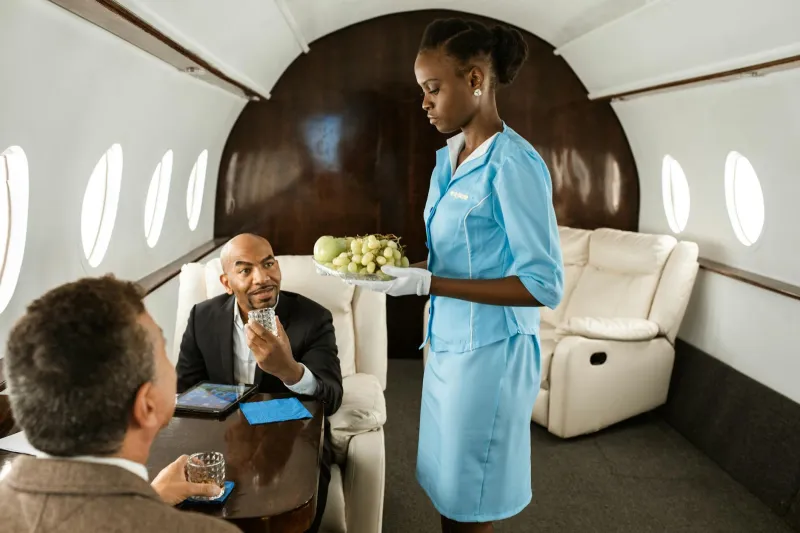
When you board a Pan Am or TWA aircraft, a flight attendant—always impeccably dressed, always smiling—greets you by name. The cabin is spacious. Your seat reclines fully into a bed. The meal service isn't a snack; it's a three-course dinner on real china with real silverware. Complimentary champagne flows. Cigarette smoke drifts lazily through the cabin (a detail modern travelers can appreciate from a distance). For most passengers, this is the closest they'll ever get to luxury living.
The catch? A cross-country ticket costs roughly $1,200 in today's money. Flying is for the wealthy, the business elite, and those marking major life moments. For ordinary Americans, it remains an exotic, almost mythical experience.
The Democratization Gamble
By the 1970s and 80s, the airline industry faced a choice. Deregulation was opening the market. Jet fuel was becoming cheaper. Aircraft were getting bigger. Airlines could either preserve the premium experience for a select few, or they could race to the bottom and sell seats to the masses.
They chose the latter. And in choosing it, they fundamentally rewired how Americans experience travel.
Budget carriers like Southwest pioneered the no-frills model: eliminate the meals, shrink the seats, stack passengers tighter, turn planes around faster. The genius was that it worked. Suddenly, a teacher in Ohio could afford to visit her sister in California. A young couple could take a honeymoon. Grandparents could see grandchildren across the country several times a year. Air travel shifted from luxury to utility.
The math was undeniable. A ticket that cost $1,200 in 1965 now costs $300 in 2024—adjusted for inflation, that's roughly one-quarter the price. Millions of Americans who would never have flown now fly regularly. The accessibility is real, and for many people, it's genuinely transformative.
The Price of Admission
But here's what happened along the way: the entire experience collapsed.
Walk into an airport terminal today and you'll see people in sweatpants, gym clothes, pajamas. Not because comfort matters more (though it does), but because nobody dresses up to fly anymore. It's indistinguishable from waiting in a DMV—functional, impersonal, occasionally frustrating.
Board your flight and you're greeted by a harried attendant navigating a gauntlet of 180 passengers. Your seat is 17 inches wide. It reclines about 6 inches. Your knees touch the seat in front of you. The "meal" is a small bag of pretzels and a beverage for which airlines have started charging. Legroom? That's a premium upgrade. Checked bag? $30. Carry-on? $40 on some carriers. Seat selection? $15 to $25.
What was once included in the ticket price is now itemized and monetized. The flight itself is just the base product; everything else is a revenue stream.
The cabin experience has become so compressed, so standardized, so utterly devoid of grace that airlines now sell the illusion of comfort as a luxury tier. Business class on a domestic flight—which used to be a modest upgrade—now costs three times the economy fare and promises amenities that were standard in economy fifty years ago.
What We Gained and Lost
The research on this trade-off is complicated. Economists celebrate the efficiency. Millions of people have access to mobility they never had before. That matters. A single mother working two jobs can now afford to fly home for Christmas. A college student can take an internship across the country. The democratization of flight has genuinely expanded human possibility for ordinary people.
But sociologists and cultural observers notice something else: the loss of ritual. Flying used to mean something. It was an occasion that marked transitions, celebrated achievements, connected distant people in ways that felt momentous. You dressed up because the experience deserved respect. You arrived early because there was something to experience in the terminal itself.
Now? You show up 90 minutes before departure, shuffle through security, sit at a gate that looks identical to every other gate, and endure three hours of compressed discomfort to arrive at your destination.
The writer and cultural critic Malcolm Gladwell once observed that we've optimized air travel for speed and cost while completely abandoning the idea that the journey itself might be worth savoring. We've made flying ubiquitous while making it miserable.
The Middle Path Nobody Took
There's a counterfactual worth considering: What if the industry had chosen a middle path? What if we'd expanded access while preserving some sense of care and spaciousness? What if we'd decided that even economy passengers deserved meals, reasonable legroom, and attendants who had time to do more than rush through beverage service?
Some international carriers—Singapore Airlines, Qatar Airways—have demonstrated that it's possible to offer both accessibility and dignity. They're not cheap, but they're not exclusive either. They've chosen to compete on experience rather than price alone.
American carriers, by contrast, have largely ceded that territory. They've optimized themselves into a race to the bottom, where the only question is who can pack more people into a smaller space for less money.
So here's where we've landed: millions more Americans can fly. That's real progress. But the experience of flying—the sense that you're doing something special, something worth preparing for—has evaporated.
We gained access and lost magic. We gained efficiency and lost grace. We made flying democratic and made it forgettable.
The real question isn't whether the trade was worth it. It clearly was for many people. The question is whether we ever stopped to consider whether it had to be this way.