Getting Dressed to See a Movie Used to Mean Something. Now the Credits Roll While You Check Your Phone.
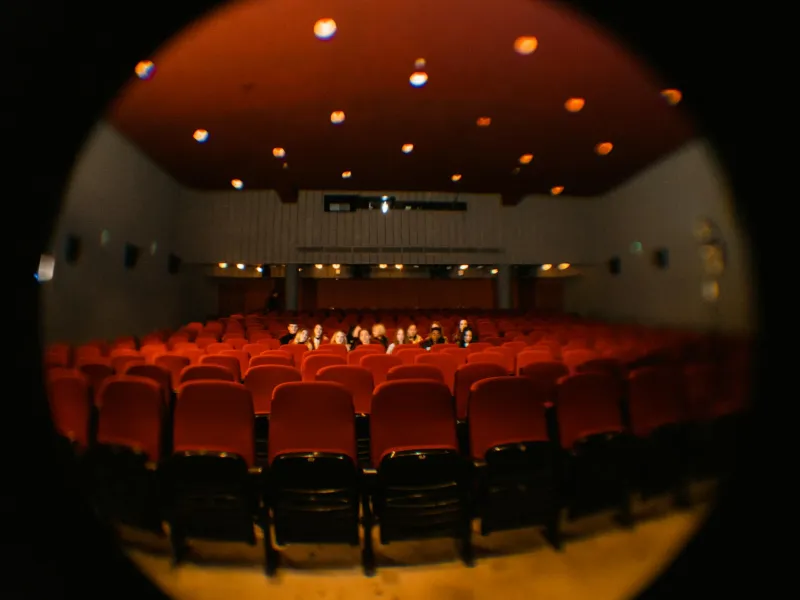
Getting Dressed to See a Movie Used to Mean Something. Now the Credits Roll While You Check Your Phone.
Ask someone over sixty about going to the movies as a kid and watch what happens to their face. There's something there that goes beyond nostalgia — a particular kind of warmth that comes from describing an experience that was, in the fullest sense of the word, an event.
The outfit. The drive. The line out front. The smell of the lobby. The moment the lights went down and the room went quiet together.
Now ask a twenty-year-old what they watched last night. There's a decent chance they're not entirely sure which platform it was on.
When the Movies Were the Main Event
In mid-century America, cinema wasn't just entertainment. It was one of the primary shared cultural experiences available to ordinary people. In the late 1940s, roughly 90 million Americans went to the movies every single week — in a country with a total population of around 150 million. That number is almost impossible to contextualize today.
Theaters were designed to feel like palaces. The grand movie houses of the 1930s and 1940s had chandeliers, uniformed ushers, and lobbies meant to make a Tuesday feel like an occasion. Newsreels played before the feature. Intermissions gave audiences a chance to stretch, buy refreshments, and talk about what they'd just seen. Reserved seating was common in premium venues. People dressed up — not for a premiere, just for a regular Saturday night film.
The drive-in added another layer to the ritual in the 1950s and 60s. At its peak in 1958, there were more than 4,000 drive-in theaters operating across the United States. Families loaded into station wagons, teenagers went on dates, and the movie became an excuse for something larger — a social occasion wrapped around a shared screen.
Jaws, Star Wars, and the Last Great Shared Moment
The 1970s brought a different kind of cinema event. Steven Spielberg's Jaws in 1975 is widely credited as the first true summer blockbuster — a film so culturally dominant that it changed the release calendar of the entire industry. Two years later, Star Wars created lines around the block that lasted for weeks.
These weren't just popular movies. They were communal experiences on a scale that's genuinely hard to recreate. People saw them multiple times in theaters. They discussed them at work, at school, at the dinner table. There was no way to see the film without going to the theater, which meant that for a brief window, everyone who wanted to participate in the cultural conversation had to show up in the same physical space.
The blockbuster era of the 1980s continued the pattern. E.T., Raiders of the Lost Ark, Back to the Future — these films landed in theaters and lived there for months, accumulating cultural weight through repeated communal viewings rather than a single opening weekend sprint.
The Long Unraveling
The erosion came in waves. VHS in the 1980s introduced the idea that you could wait — that the theater wasn't the only option, just the first one. DVD in the late 1990s made the home experience genuinely good. Multiplexes replaced grand theaters with utilitarian boxes, removing much of the ceremonial quality that had made going out feel worth the effort.
And then streaming arrived and renegotiated the entire premise.
Netflix, Hulu, HBO Max, Disney+, Apple TV+ — the sheer volume of available content transformed film from a scarce, event-driven experience into something ambient. A new movie doesn't ask for your evening anymore. It sits in a queue alongside twelve other things you've been meaning to watch, competing with the group chat and the urge to check the score of the game.
Theatrical attendance in the United States has been declining for years. Even before the pandemic accelerated the trend, annual ticket sales had dropped significantly from their early 2000s highs. In 2023, domestic box office numbers remained well below pre-pandemic levels, and studios increasingly treat the theatrical window as a marketing phase rather than the primary revenue event.
Some of the biggest films of recent years have debuted directly on streaming platforms, bypassing theaters entirely — a move that would have been unthinkable in 1985 and is now routine.
Something Got Lost in the Algorithm
It's worth being honest about what improved. The home viewing experience today is genuinely excellent. Screen sizes, sound systems, and picture quality that would have required a dedicated screening room a generation ago now fit in a standard living room. Subtitles, pause buttons, and the ability to rewatch a scene immediately are not small conveniences. Accessibility has expanded enormously.
But something specific to the communal experience has eroded in ways that are harder to quantify.
When an entire audience laughs at the same moment, gasps at the same reveal, or sits in the same stunned silence after the credits roll — that's not just entertainment. It's a shared reference point. A moment that belongs to everyone in the room equally. The collective experience of Jaws or The Sixth Sense or Get Out created cultural touchstones in a way that watching the same film alone on a laptop, two weeks after everyone else, simply doesn't.
Streaming algorithms are extraordinarily good at showing you what you'll probably like. They are structurally incapable of giving you what everyone else is watching right now and making you part of that moment.
The Quiet Shift
The movies didn't die. They mutated. The theatrical experience still exists, and for certain films — spectacles built for the big screen — it still delivers something genuinely irreplaceable. But the default has changed. Going to the movies is no longer the obvious choice for a Friday night. It requires a decision, a justification, a specific reason to leave the couch.
What we've traded is the ritual. The shared inconvenience. The fact that everyone had to show up in the same room, at the same time, and experience something together with no option to pause or scroll away.
That's a small loss in isolation. Accumulated across a culture, it's something else entirely.